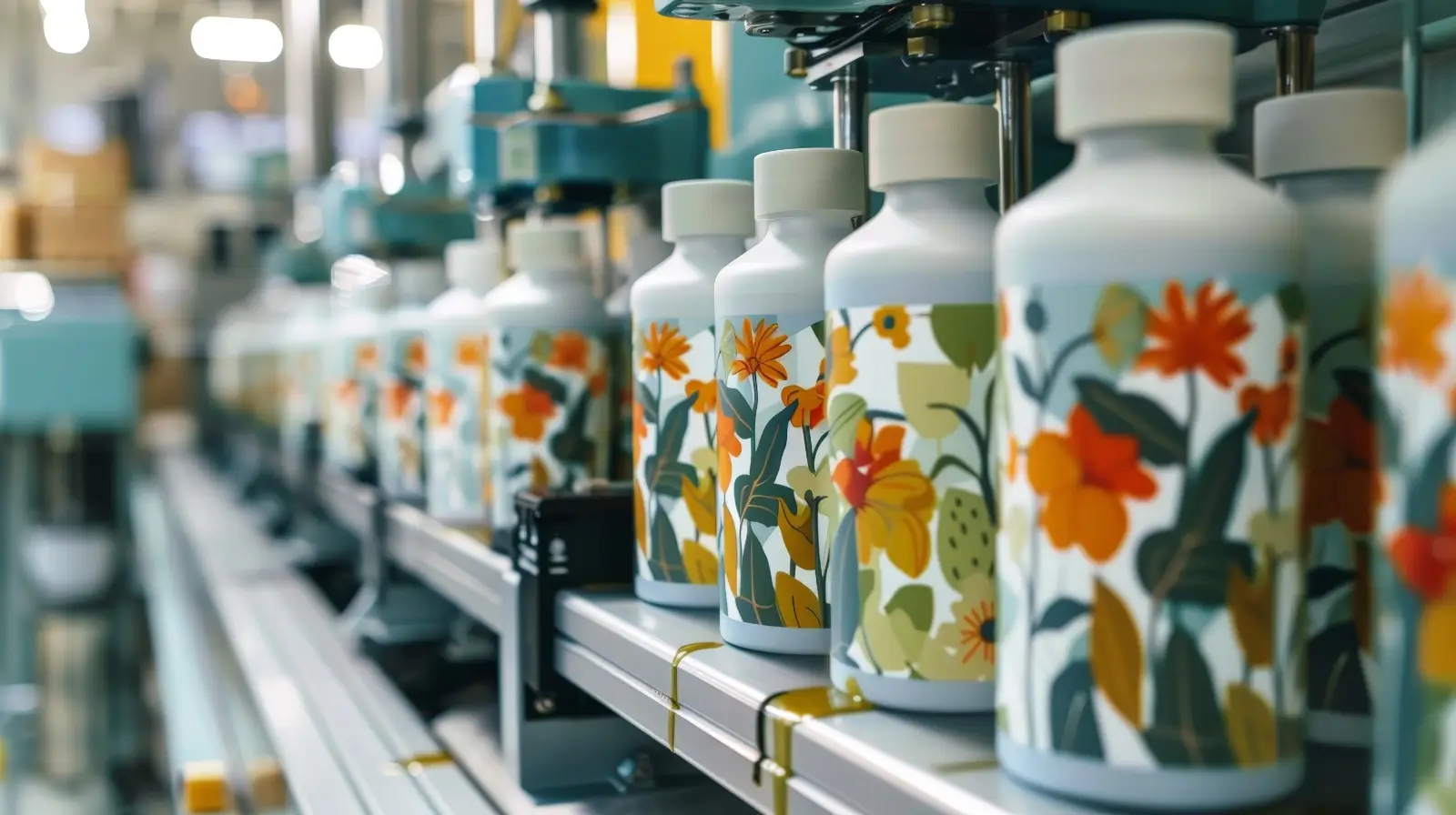
Your product label is the first thing a shopper sees - before the price tag, before the shelf talker, before anyone picks it up. This guide covers everything US brands and contract manufactures need to know before placing a label order: materials, finishes, print methods, quantities, costs and what most guides leave out.
If you have ever ordered labels that peeled off in the refrigerator, faded in sunlight or looked completely different from your screen mockup, this is the guide you needed before that order. We have built it to answer every real question that brand owners ask - not just the obvious ones.
What Are Custom Labels?
Custom label printing are adhesive stickers made to your exact specifications - size, shape, material, finish and design. They are used to brand, identify and communicate product information on packaging. Unlike generic stock labels, every detail is built around your product.
A custom label is not just a sticker. It is a substrate (the material being printed on), a face stock, an adhesive layer and a release liner - all working together to stay on your packaging through shipping, refrigeration, retail handling and the buyer's home.
At Labels Lab, we produce custom labels for brands across beverages, supplements, beauty, food, pet care, firearms and more - all printed in the USA and shipped nationwide. Every label starts with a conversation about your product, your environment and your volume.
What Label Material Should You Use?
BOPP is the most versatile choice for most product labels - it is water-resistant, flexible and works beautifully for beauty, supplement and food products. Paper suits dry retail goods. Vinyl handles harsh outdoor conditions. Polyester is built for extreme environments.
Choosing the wrong label material is one of the most common (and costly) mistakes brands make. The substrate determines how your label performs after it leaves the printer - not just how it looks in a mockup.
Paper Labels
Paper is affordable and prints beautifully, giving labels a warm, natural feel that works especially well with matte or kraft finishes. It is the right call for dry indoor products like coffee, candles, dry spices and gift items. The downside: paper tears and curls when exposed to moisture, so it is a poor fit for anything that lives in a refrigerator or gets wet during use.
Best for: coffee bags, candle jars, dry spices, specialty food items, indoor retail products.
BOPP Labels
Biaxially oriented polypropylene (BOPP) is a thin, flexible plastic film that is water-resistant, tear-resistant and conforms easily to curved surfaces. It is available in white film for a traditional label look or clear film for a no-label, minimalist effect directly on a bottle. BOPP is the gold standard for beauty, skincare, supplements and beverage products, any category where the packaging gets handled frequently or encounters moisture.
Best for: bottles, supplement jars, skincare, beverages, food products that encounter moisture.
Vinyl Labels
Vinyl is thicker and significantly more durable than BOPP. It resists UV exposure, chemicals, abrasion and extreme temperatures. Vinyl labels are common for industrial applications, outdoor equipment and products that need to survive harsh physical conditions. They are also popular for promotional stickers and brand decals.
Best for: industrial, outdoor, chemical products, brand decals, equipment stickers.
Polyester (PET) Labels
Polyester labels are built for environments where both heat resistance and chemical resistance matter. They do not shrink, stretch or warp under temperature swings. These labels are used in automotive, laboratory and high-demand industrial applications.
Best for: automotive products, laboratory vials, industrial equipment, extreme environments.
What's the Difference Between Matte and Gloss Labels?
Gloss labels are brighter and more vibrant - they make colors pop and are the more affordable choice. Matte labels have a flat, premium feel that signals sophistication. Neither is objectively better; the right choice depends on your brand tier and product category.
Gloss Labels
A gloss laminate gives your label a shiny, high-contrast surface. Colors appear more vivid and the coating adds moisture resistance at a competitive price point. Gloss labels photograph well, which is a real advantage for products sold online. They are the most widely used finish across food, beverage and consumer goods.
Matte Labels
Matte labels have a soft, flat finish that reads as premium. They are widely used in luxury skincare, craft beverage and supplement brands that want a refined, high-end look. One practical note: matte labels are slightly harder to write on, which can matter if you apply batch codes or expiry dates by hand after printing.
Beyond the Basics: Specialty Finishes
The most impactful label upgrades are often achieved through specialty finishing techniques:
- Spot UV - a glossy varnish applied selectively over specific design elements (like logo) on a matte background, creating contrast and depth.
- Soft touch lamination - a velvety, tactile coating that feels premium. Widely used in luxury skincare and spirits.
- Foil stamping - reflective gold or silver foil applied to specific design areas. Available as hot foil (deeper impression) or cold foil (more design flexibility).
- Holographic effects - light-reactive, iridescent effects ideal for limited editions, spirits and collector products.
- Embossed labels - a raised tactile effect applied to logos or design elements. Often paired with soft touch laminate for maximum shelf impact.
Labels Lab produces all of these finishing options in-house. Visit the page labels to see them in action.
What Is the Difference Between Digital and Flexographic Label Printing?
Digital printing is ideal for short runs, fast turnarounds and designs with variable data. Flexographic printing excels at high volumes with consistent color reproduction. Most growing brands will use both at different stages.
Digital Label Printing
Digital printing sends your artwork directly to the press - no plates, no tooling, no setup fee. This makes it the right choice for short-run label printing, product launches and test markets. You can order as few as 100-500 labels economically and you can print variable data (unique QR codes, batch numbers or serial numbers) on each label at no extra cost. Brands that frequently update their artwork or run multiple product variants also benefit greatly from digital printing.
Flexographic Label Printing
Flexo printing uses engraved plates and fast-drying inks to print at very high speeds. The cost per label drops significantly at scale, making it the most efficient option once your product volumes are established. Flexo handles specialty inks - metallics, UV-reactive, opaque white - extremely well and delivers consistent color reproduction across long runs.
At Labels Lab, we offer both digital and flexographic printing, so you are not forced into one process. We match the method to your volume and timeline - not the other way around.
| Print Method | Best For |
| Digital | Short runs (500-5,000), fast turnaround, variable data, test markets, frequent artwork updates |
| Flexographic | High volume (10,000+), consistent color, specialty inks, cost-effective at scale |
| Both | Growing brands: start digital, transition to flexo as volumes stabilize |
What Are Pressure-Sensitive Labels?
Pressure-sensitive labels are self-adhesive labels that bond to a surface when pressed - no heat or water required. The vast majority of product labels you encounter every day are pressure-sensitive. Within this category, you choose the adhesive type based on your application environment.
The term "pressure sensitive" refers to the adhesive mechanism. The label is produced on a release liner (the backing paper you peel off) and bonds to your container when you apply pressure. Pressure-sensitive labels can be applied to glass, plastic, metal, cardboard and most smooth surfaces.
Adhesive options within pressure-sensitive labels:
- Permanent adhesive - bonds strongly and is difficult to remove without damage. Best for most product labeling applications.
- Removable adhesive - peels cleanly from smooth surfaces without leaving residue. Useful for promotional labels, samples or seasonal items.
- Freezer-grade adhesive - specially formulated to maintain adhesion at temperatures well below freezing. Required for frozen food products and ice bucket items.
- High-tack adhesive - used for rough or textured surfaces where standard adhesives may not grip properly.
If you are applying labels with automated equipment, your labels need to be specified for your machine - roll core size, web width and label gap all matter. Labels Lab works with your application process from the start. Mention your equipment when requesting a quote and we will make sure everything runs correctly out of the box.
How Much Do Custom Label Printing Cost?
Pricing for Custom label printing depends on material, size, finish, print method and most importantly - quantity. Digital short runs might cost $0.08-$0.30 per label. Flexo at high volume can drop below $0.03 per label. The biggest cost lever you control is order size.
This is the question most label guides avoid giving a straight answer to. Here is what actually drives the cost of your labels:
| Cost Factor | How It Affects Pricing |
| Quantity | The single biggest lever. Setup costs are spread across the run - more labels = lower unit cost. |
| Material | BOPP costs more than paper; polyester and vinyl cost more than BOPP. |
| Finish | Gloss laminate is the most affordable. Matte, spot UV, foil and soft touch each add cost. |
| Print Method | Digital has no setup fee but higher per-unit cost. Flexo has plate costs but lower unit cost at scale. |
| Colours & Inks | CMYK is more affordable than Pantone spot colors. Metallic, white or neon inks add cost. |
| Shape | Standard shapes (rectangle, circle) cost less than custom die-cut shapes. |
| Packaging | Roll vs. sheet, labels per rolland core size all affect the total. |
A practical rule: if you are ordering 1,000 labels 12 times a year, consolidating into one or two bulk orders will almost always cost less overall - even after accounting for storage. Talk to our printer about annual volume planning before placing your first order.
How Many Labels Should You Order?
Order enough to cover three to six months of sales plus a buffer for quality checks, retail placement and sampling. For most early-stage brands, this means 500-2,000 labels per SKU. Scaling brands with stable artwork should explore flexo pricing at 5,000 units and above.
Ordering too few labels drives up cost per label and creates reorder stress. Ordering too many before your product is stable means writing off labels when artwork, ingredients or sizing change. Here is a practical framework:
- New brand, pre-launch: 250-500 labels. Keep artwork flexible - real-world use almost always triggers changes.
- Established product, retail launch: 1,000-5,000 labels. Enough to cover initial retail orders with a safety buffer.
- Scaling brand with stable artwork: 5,000-25,000+ labels. At this volume, flexo printing delivers the best cost per label.
- Multi-SKU brands: Consider printing multiple designs in one digital run - Labels Lab supports multi-design runs at no additional setup cost.
What Goes on a Custom Product Label?
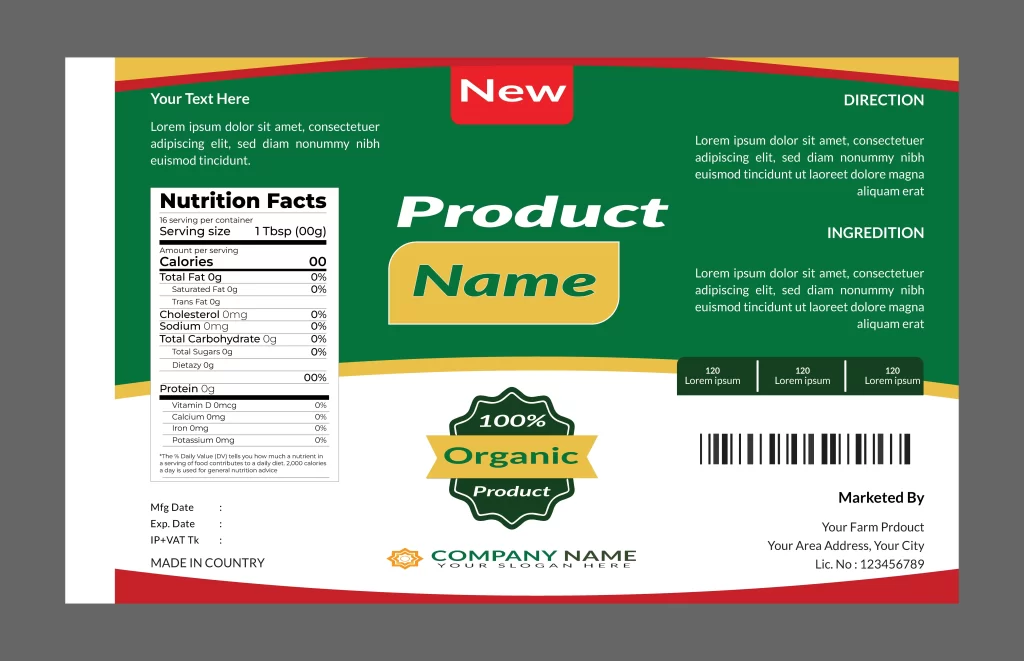
Every product's custom label printing should carry your brand name, product name, net quantity, key claims and contact information. Beyond the essentials, your label's job is to answer three questions in under three seconds: What is this? Who makes it? Why should I want it?
The strongest product labels balance visual impact with clear communication. Here are the core elements to include:
- Brand name and logo
- Product name and variant (flavor, scent, strength or size)
- Net quantity - weight, volume or unit count
- Key claims or benefits - organic, cruelty-free, non-GMOand similar claims if applicable
- Manufacturer name and address or website URL
- Barcode (UPC or EAN) if required
- QR code for digital engagement, traceability or extended product information
- Lot number or batch code - can be applied at print or post-print via variable data printing
How Long Does Custom Label Printing Take?
Standard turnaround for most custom labels is 5-10 business days after artwork approval. Digital orders with existing print-ready artwork can ship faster. Rush turnaround options - including same-day printing and next-day label printing - are available for qualifying orders at Labels Lab.
Turnaround time is driven by print method, finishing complexity and artwork readiness. Here is a realistic timeline breakdown:
- Artwork review and revision cycles: allow 1-3 business days.
- Digital printing jobs: typically complete in 3-7 business days.
- Flexographic jobs (new plate creation): typically require 7-15 business days.
- Specialty finishes (foil, embossing, soft touch): add 2-5 business days.
- Rush and same-day options: available at Labels Lab for qualifying digital orders.
The single biggest delay in most label orders is slow artwork approval. Get your design print-ready before you reach out and your order will move significantly faster.
Are Custom Labels Better Than Stock Labels?
For any consumer-facing product, yes. Custom label Printing build brand recognition, communicate value and differentiate your product at the point of sale. The cost gap between custom and stock labels has narrowed dramatically thanks to digital short-run printing - you can now order 500 custom labels with no setup fee.
Stock labels are only appropriate for internal use - warehouse labeling, plain shipping labels or blanks for handwriting. For anything a customer sees, custom product labels are the better investment.
The economics have changed significantly. A decade ago, small brands had to order thousands of labels at a time to make custom printing affordable. Today, digital printing means you can order exactly what you need, in exactly the quantity you need, with your full artwork - at a unit cost that is competitive with many stock label options.
What Makes a Good Label Printing Partner
Choosing a custom label printing company is a long-term decision. The questions to ask before you commit:
- Do they have direct experience with your product category? A printer that specialises in supplement labels thinks differently from one that primarily handles industrial labels.
- Do they offer digital and flexographic capabilities? A printer limited to one method will push you toward that method regardless of your volume.
- Do they provide a physical sample or digital proof before the full run? This step should never be optional.
- What are their minimum order quantities? Low minimums are critical for early-stage brands.
- Do they offer label design support? Artwork that is not print-ready will delay your order.
- Can they scale with you? A printer that handles 500-label test runs and 500,000-label production runs under one roof saves you the disruption of switching vendors as you grow.
- What is the quality guarantee? Understand the reprint policy before the first order.
- For contract manufacturers, the definition of a good label printing partner is different. It is not just about print quality, it is about operational reliability, consistency across batches and the ability to support multiple client SKUs without delays.
According to Smithers, the global label market is projected to surpass $60 billion by 2028, driven largely by growing CPG brands and direct-to-consumer businesses demanding high-quality custom labels at flexible volumes.
Labels Lab Custom Label Capabilities
Labels Lab is a USA-based custom label printing company operating out of Las Vegas, Nevada. We serve brands across every major CPG category with both short-run digital label printing and high-volume flexographic production.
What sets us apart:
- Both digital and flexographic capabilities under one roof - you get the right process for your volume without switching vendors.
- Low minimums - short-run digital label printing starting from 100 labels per design.
- No setup fee on digital runs - your first order and your fiftieth order are equally efficient.
- Multi-design label printing - print multiple SKU designs in a single run with zero additional setup cost.
- Variable data printing (VDP) - unique QR codes, serial numbers, batch numbers or expiry dates on every label at no extra tooling cost.
- Full-service design team - print-ready artwork preparation and label design from scratch.
- Fast turnaround and same-day label printing options - for when your timeline is urgent.
- Nationwide shipping - from Las Vegas to your warehouse or co-packer anywhere in the USA.
Label Finishing Options That Elevate Your Packaging
Die-Cut Labels
Die-cut labels are cut to any shape - circles, ovals, rounded rectangles or fully custom contours that mirror your logo or product silhouette. A shape that is unique to your brand stands out immediately on the shelf. Labels Lab produces die-cut labels in any shape with no tooling fee on digital runs.
Foil Labels
Gold and silver foil labels signal luxury. Foil can be applied across the whole label or selectively to design elements. Cold foil applied digitally offers more design flexibility; hot foil stamping gives a deeper, more tactile metallic impression. Both are available through Labels Lab.
Holographic Labels
Holographic BOPP material creates a rainbow shimmer effect under light - effective for beauty, spirits and collector products. Holographic elements can also be selectively applied to specific design areas.
Spot UV Labels
Spot UV applies a glossy, light-catching varnish to specific areas of your label (typically your logo or key art) while the rest remains matte. The contrast between glossy and matte creates depth and draws the eye immediately to your brand mark.
Common Mistakes Brands Make When Ordering Custom Labels
1. Submitting artwork in RGB instead of CMYK. Your monitor displays color in RGB, but printing uses CMYK. Colors that look vibrant on screen often appear duller in print. Always convert your artwork to CMYK before submitting and ask the printer for a sample proof if color accuracy is critical.
2. Ordering without testing the adhesive on your container. Not all adhesives bond equally to all surfaces. Textured glass, matte plastic and flexible pouches each require specific adhesive formulations. Always request a sample run before committing to a large order.
3. Not accounting for application. If you are applying labels by machine, your label specs (roll direction, core size, label gap, liner type) must match your equipment. If you are applying by hand, this matters less - but roll format vs. sheet format is still worth discussing.
4. Choosing the cheapest material for the environment. Paper labels in a refrigerated environment will curl, peel and look terrible within days. Choose your material based on where your product lives, not just what looks good in a mockup.
5. Updating your artwork after a large order. If your label is still evolving (ingredients, claims, sizing), keep your early runs short. Digital short-run printing was designed exactly for this stage.
Packaging for Contract Manufacturers: Built for Scale, Speed and Consistency
Contract manufacturers operate in a completely different environment from typical product brands. You are not producing one SKU at a time. You are managing multiple clients, multiple packaging formats and strict production timelines - all at once.
At Labels Lab, we work directly with contract manufacturers as long-term packaging partners, not just label suppliers.
We support contract manufacturing operations with:
- Multi-SKU label production across different client brands
- Consistent color matching across repeat production runs
- Label specifications aligned with automated application lines
- Fast turnaround to match production schedules
- Scalable print capabilities from short runs to high-volume production
Whether you are filling beverages, supplements, food products or personal care items, your packaging workflow depends on precision and reliability. A label delay can slow down an entire production line. A mismatch in specs can cause application errors at scale.
That is why we align with your process from the start, including roll direction, core size, label gap and material performance, ensuring labels run smoothly on your equipment without rework.
We do not just print labels. We integrate into your production workflow.
If you are a contract manufacturer looking for a packaging partner who understands co-packing environments, we are built for that.
Explore More From Labels Lab
Ready to find the right packaging for your industry?
- Water & Beverage Packaging
Shrink sleeves and flexible packaging for bottles and cans - Coffee & Tea Packaging
Custom label printing solutions for coffee bags, tea pouches and retail products - Supplement & Nutraceutical Packaging
Sachets and packaging for capsules, powders and liquids - Vitamins Packaging
Packaging solutions for health products and daily supplements - Skincare & Cosmetic Packaging
Tubes, cartons and premium finishes for beauty and personal care products - Food Packaging Solutions
Pouches and boxes for dry, fresh and packaged foods - Pet Care Packaging
Packaging for pet food, treats and grooming products - Liquor, Beer & Spirits Packaging
Premium packaging for bottles and cans - Peptides Packaging
Specialty packaging for research and controlled environments
Final Thoughts
Custom label printing are one of the highest-impact decisions you make when building a product brand. The right label speaks before your product gets picked up. It earns shelf space, builds trust and turns a first-time buyer into a repeat customer.
The fundamentals are straightforward: match your material to your environment, choose a finish that reflects your brand tier, understand your volume so you order efficiently and work with a printer who has handled products like yours before.
Labels Lab specialises in custom label printing for US brands - from startups testing their first 500 units to established companies printing millions of labels annually.
Frequently Asked Questions
For digital custom label printing, most orders start as low as 500 labels per design with no setup fee. For flexographic printing, minimum runs are typically higher and depend on the label size and material. Contact Labels Lab for a quote on your specific quantity and we will match you to the right process.
Yes. With digital printing, you can print multiple designs in the same production run without additional setup costs. This is called multi-design label printing and is ideal for product variants, seasonal packaging or test markets where you need small quantities of several different labels at once.
For custom label printing most printers prefer print-ready vector files in PDF, AI (Adobe Illustrator) or EPS format, with all fonts outlined and artwork set to CMYK color mode at 300 DPI minimum. If your artwork is not print-ready, Labels Lab's design team can prepare it for you. Avoid submitting files built in RGB - the color shift in print can be significant.
BOPP is a material; waterproof is a performance characteristic. Most BOPP labels are water-resistant, but the level of resistance depends on both the substrate and the adhesive. If your product will be submerged or stored in ice, ask specifically about freezer-grade adhesive and fully waterproof-rated label options when you request your quote.
Variable data printing (VDP) allows each label in a run to carry unique information - different QR codes, serial numbers, lot numbers or expiry dates. It is valuable for brands that need traceability, personalization or lot tracking. Digital presses handle VDP natively with no extra tooling cost. Flexo does not support VDP economically. If traceability is part of your product's story or requirements, this is a reason to stay on digital even at higher volumes.
Labels Lab offers sample runs for brands that want to test label quality, adhesion and appearance before a full production order. Ask about sample pricing when you request your quote. This step is especially important if you are using a new container shape or material for the first time.
Gloss lamination adds a shiny, protective coating that makes colors appear vivid and bright. Matte lamination creates a flat, sophisticated finish with reduced glare. Both add durability and moisture resistance. The choice comes down to your brand aesthetic: gloss reads as bold and energetic &matte reads as refined and premium.
Reference
- Global label market data (Smithers)
- Industry news and label material trends (Packaging Digest)
- Flexible packaging and label material standards (Flexible Packaging Association)
- QR & Barcode guidance (GS1 US)
About Labels Lab Team
“This guide was created by the Labels Lab Team, specialists in custom label printing and packaging solutions for US brands, with hands-on experience across beverages, supplements, skincare and food products.”

